
The Beginner's Trap:Memorising Songs Without Understanding Music

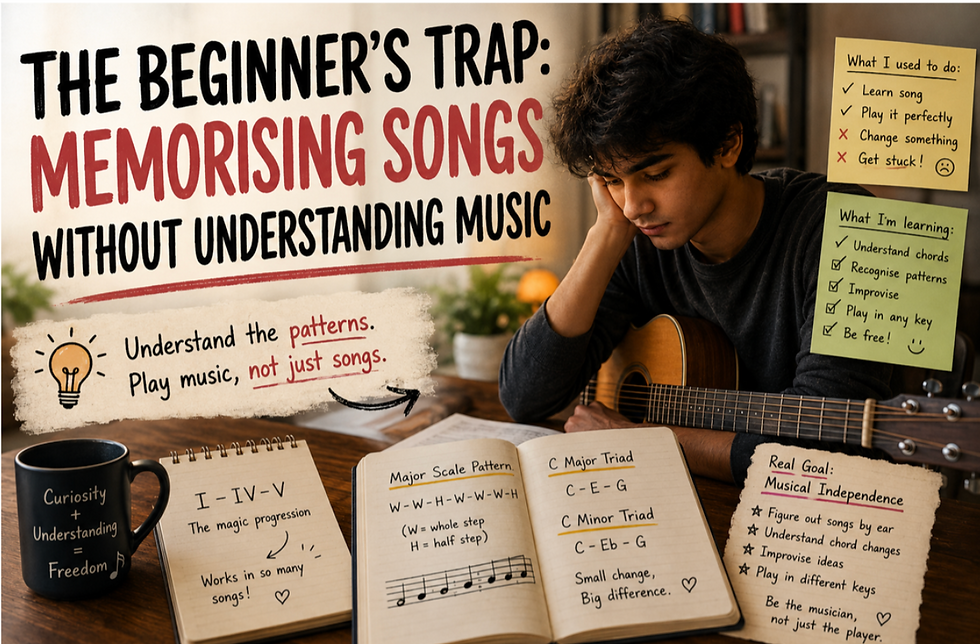
Almost every beginner musician has this moment.
You finally learn a song from start to finish. Your hands know where to go, you don't stop midway, and honestly, it feels amazing. You play it for someone and feel proud of yourself, and you should.
But then someone asks:
Can you play it in another key?
Or: Can you improvise over these chords?
And suddenly everything falls apart.
That's when you realise something important: you learned the song, but you didn't really understand the music behind it.
A lot of beginners fall into this trap without even noticing. They spend months memorising songs note by note, but the moment something changes, they feel completely lost.
Copying vs Learning
Copying is useful in the beginning. It helps you build coordination, confidence, and familiarity with your instrument. But copying alone is like memorising answers for an exam without understanding the chapter itself.
You can repeat it.
But you can't adapt it.
Real learning starts when you begin asking:
• Why does this sound good?
• Why does this chord feel emotional?
• Why does this part create tension before the chorus?
Once you start understanding the logic behind music, songs stop feeling random. You begin noticing that the same patterns appear everywhere.
That's when learning becomes easier and way more fun.
The musicians who seem like they can "play anything" usually aren't relying on memory alone. They understand the language of music, so they can recognise patterns instead of starting from zero every time.
The Basics of Chord Theory (Without the Complicated Stuff)
You don't need to become a theory expert overnight. But learning a few basic ideas can completely change the way you approach music.
Everything starts with notes and intervals.
An interval is simply the distance between two notes. Different distances create different feelings.
That's why major chords sound bright and happy while minor chords feel darker or emotional.
Then come triads, the most basic type of chords.
A major chord is built using three notes of a major scale:
Root
Major third
Perfect fifth
For example: C major scale = C D E F G A B C
C major = C-E-G
If you lower the middle note by a semi tone/half step:
C-Eb-G
It becomes C minor.
That tiny change completely changes the emotion of the chord.
Once you understand this pattern, chords stop feeling like random shapes you memorise.
You start seeing the system behind them.
And then there are chord progressions.
You'll notice that so many popular songs use the same few progressions again and again.
One of the most famous is the I-IV-V progression, used in countless rock, blues, and pop songs.
Once you recognize these patterns, learning new songs becomes much faster because your brain starts connecting ideas instead of storing isolated information.
Patterns Are Everywhere
One of the biggest realizations musicians have is this:
Music is mostly patterns.
Scales follow patterns.
Chords follow patterns.
Rhythms follow patterns.
For example, every major scale follows the same structure:
W-W-H-W-W-W-H
(w- whole step/whole tone; h- half step/semi tone)
Once you understand that pattern, you can build any major scale on any note.
That's incredibly powerful.
Instead of memorizing hundreds of separate things, you start learning the small set of rules that create them.
It's like learning how sentences work instead of memorizing every sentence ever written.
Musical Independence: The Real Goal
The ultimate goal isn't just learning songs.
It's becoming independent as a musician.
That means:
Figuring out songs by ear
Understanding chord changes
Improvising ideas
Playing in different keys
That freedom comes from combining technique with understanding.
A lot of students think progress only comes from practicing longer hours. But often, the students who improve fastest are simply the ones who stay curious.
They ask:
Why does this work?
Not just:
How do I copy this?
If you feel stuck after learning a bunch of songs, don't get discouraged. It probably just means you're ready for the next stage of learning.
Spend some time understanding what your hands are actually playing. Learn how chords are built.
Start recognising patterns by ear.
That connection between your fingers, your ears, and your understanding, that's where real musicianship begins.


Comments